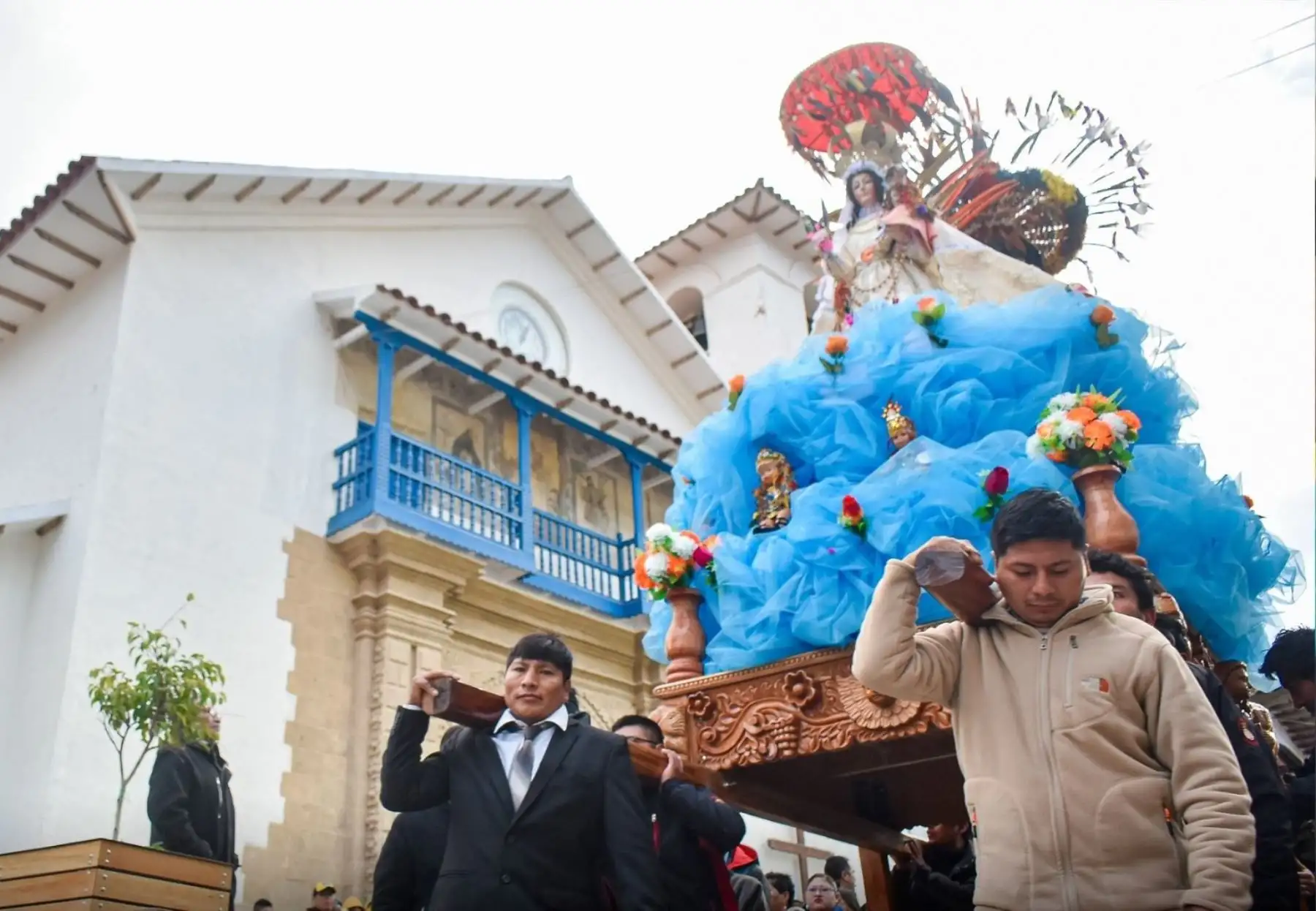
Every October, Paucartambo honors Mamá Rosario through processions, dance and ceremonies blending Catholic devotion with Andean memory. The 2026 celebration is announced for October 6–8; this guide explains what is confirmed, what visitors can expect and how to travel from Cusco.
Updated September 29, 2026. The Virgin of the Rosary Festival in Paucartambo will bring devotees, dancers, musicians and visitors together from October 6 to 8, 2026. Mamá Rosario is carried through the Cusco town’s white streets and blue balconies as local dance groups perform stories shaped by faith, territory and community memory.
What is the Virgin of the Rosary Festival in Paucartambo?
The celebration honors Our Lady of the Rosary, affectionately known as Mamá Rosario or Mamacha Rosario. Devotees, carguyoq sponsors, stewards, musicians and traditional dances accompany the image from the church bearing her name. A study listed in Concytec’s ALICIA repository describes the festival as central to local identity, linking Indigenous, Catholic and artistic expressions.
When is the festival in 2026?
The announced main dates are Tuesday, October 6, through Thursday, October 8. Mincetur’s tourism inventory also lists October 8 as Paucartambo’s traditional Virgin of the Rosary date. Spiritual preparations may begin earlier: in 2025 the Dawn Procession took place on October 1 and novena Masses continued until the main days.
The hour-by-hour schedule can change each year. The sequence below reflects documented traditions and should be checked against the final 2026 municipal programme.

Not the Virgen del Carmen or the Rosary festival of Huallhua
Paucartambo’s Virgin of the Rosary is celebrated in October. The town’s much larger Virgen del Carmen festival runs from July 15 to 18. Both images are kept in the same colonial church, but the festivals have different calendars and organizers. This is also distinct from the Virgin of the Rosary of Huallhua in San Salvador, Calca.
The colonial Church of Our Lady of the Rosary
The church stands by Paucartambo’s main square, near the colonial Carlos III bridge. Research places its construction in the late seventeenth century. Its stone portal, open chapel, adobe walls, bell tower and tiled roof form part of the town’s historic identity.
Following four years of work, the church reopened after restoration in October 2023. Archaeological research and conservation costing more than six million soles revealed layered floors, ceramic fragments and wall paintings, according to Andina.

How the October 6–8 celebration unfolds
Andina’s 2025 report documents the core sequence. Early October brings the Dawn Procession, Rosary prayers, devotional images and novenas. October 6 traditionally opens with firecrackers, bells, music, visits to former stewards and an Inkari Maqana offering to Pachamama. October 7 features the main Mass, the Bosque gift-giving scene, the Once distribution of bread and pastries, and the first procession. October 8 includes a cemetery pilgrimage honoring former dancers, another procession, the blessing of the four regions of Tawantinsuyo, dance presentations, the Guerrilla and the farewell Kacharpari.
Dances and the Guerrilla
A municipal account describes Chunchadas and Inkari Maqana confronting one another in the Guerrilla, with Salqa Qollas and Wayri Chunchos also participating. The fall of the Chunchadas’ queen closes the performance. This is not a real fight: it is a ritual drama expressing memories of the Antisuyo, community territory and the Virgin’s presence in Paucartambo.

How to get from Cusco to Paucartambo
Mincetur records a 105.5-kilometre road journey taking about 2 hours 15 minutes by tourist bus. Festival traffic can lengthen the trip. Organized transport is the most predictable option; public-transport schedules and return times should be confirmed directly with operators. Drivers should travel in daylight and avoid streets reserved for processions.
Practical and respectful travel advice
- Book early because local accommodation is limited.
- Carry cash, rain protection, warm layers, sunscreen and secure footwear.
- Ask before close-up portraits and never block a procession.
- Do not touch masks, platforms or devotional images.
- Respect the church, historic balconies and marked dance areas.
- Check the final programme 48 hours before departure.
Allow time for the Carlos III bridge, the restored church and the white-and-blue historic streets. With additional days, combine the trip with a Cusco City Tour or the Sacred Valley.
Verified sources and 2026 updates
This guide uses the Municipality of Paucartambo, Mincetur, Andina and ALICIA–Concytec. This URL will be updated when the detailed municipal timetable, procession routes and traffic plan are released.
GT Peru Travel editorial team
Culture and travel · GT Peru Travel · Cusco, Peru
Information checked against the Municipality of Paucartambo, Mincetur, Andina and Concytec’s ALICIA repository.