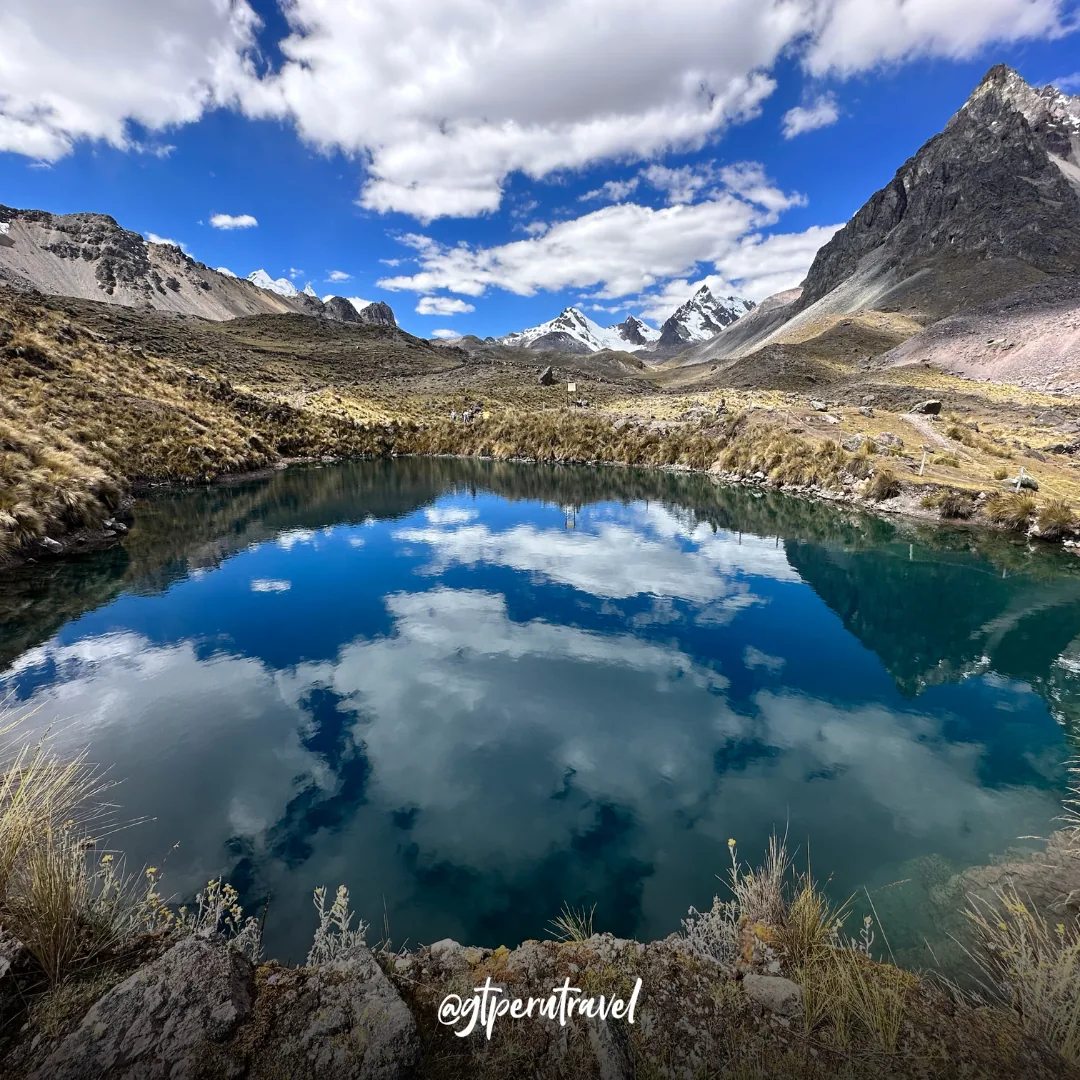
The Ausangate 7 Lakes circuit is a high-altitude hike that starts in Pacchanta and crosses a chain of glacial lakes beneath one of Cusco's most important snowcapped mountains. It is spectacular, but the elevation requires acclimatization, warm clothing and responsible planning.
Quick answer: the Ausangate 7 Lakes are near the community of Pacchanta in the district of Ocongate. From Cusco, the experience takes a full day: the drive usually takes 3 to 4 hours each way and the hike 4 to 6 hours, depending on the route and the group's pace. The trail starts above 4,200 m and may approach 4,700–4,800 m, so it should not be attempted on your first day at altitude.
Ausangate 7 Lakes: key facts
| Detail | Practical reference |
|---|---|
| Location | Pacchanta, Ocongate district, Quispicanchi province, Cusco |
| Duration | Full day from Cusco |
| Driving time | Approximately 3–4 hours each way |
| Hiking distance | About 8–13 km; roughly 4–6 hours |
| Altitude | Starts around 4,200–4,300 m; high points near 4,700–4,800 m |
| Difficulty | Moderate to demanding because of altitude and duration |
| Best season | April to October for a greater chance of dry weather |
| Trailhead | Pacchanta community |
What are the Ausangate 7 Lakes?
They are high-Andean lakes fed by snow and glacial melt from the Vilcanota mountain range. Their colors shift between blue, turquoise, green and darker tones according to light, depth and surrounding minerals. The landscape combines glaciers, wetlands, alpaca herds and mountains that local communities regard as part of a sacred territory.
Ausangate rises to approximately 6,384 m and is recognized as an apu, a protective mountain in Andean worldview. In 2024, the District Municipality of Ocongate declared the mountain, the Seven Lakes circuit and the Pacchanta and Upis hot springs to be of tourist interest.

What are the names of the seven lakes?
The most commonly published list includes Pucacocha, Patacocha, Alqacocha, Qomercocha, Orco Otorongo, China Otorongo and Azulcocha. Spelling and order can vary with Quechua transcription, the trail in use and the guide's interpretation. Some itineraries use alternative local names, so think of them as a community-managed circuit rather than seven identical points on every map.

How to get there from Cusco
The road follows the corridor toward Ocongate and continues to Pacchanta, where the hike starts and ends. Conditions, detours and travel times can change during the rainy season.
- Organized tour: the most practical way to complete the trip in one day. Check whether transportation, a guide, meals, entrance fees and emergency oxygen are included.
- Independent travel: requires arranging transportation to Ocongate or Tinki and then local transport to Pacchanta. Return connections are variable, so an overnight stay or a prearranged vehicle is safer.
If you prefer to have the logistics arranged, see the Ausangate 7 Lakes full-day tour from Cusco. GT Peru Travel currently lists prices from USD 40 per person for bookings of two or more travelers, subject to availability.
Entrance fee and additional costs
Access is managed locally and is not included in the Cusco Tourist Ticket. As a reference checked in November 2026, several route operators publish a community fee of approximately S/ 20 per person and an additional fee of about S/ 5 for the Pacchanta hot springs. These amounts can change, so confirm with your operator and carry Peruvian soles in cash.
Before booking, compare exactly what is included: transportation, guide, breakfast, lunch, hiking poles, entrance fees, hot springs and oxygen assistance. The lowest advertised price may not cover every payment during the day.
Typical full-day itinerary
- Departure from Cusco: usually between 4:00 and 5:00 a.m.
- Drive to Pacchanta: breakfast and preparation for the hike.
- Lake circuit: gradual ascent through wetlands, slopes and viewpoints.
- Return to Pacchanta: lunch and an optional visit to the hot springs if time permits.
- Return to Cusco: typical arrival between 6:30 and 8:00 p.m., depending on traffic and the group.
Times are approximate. In the high mountains, it is unsafe to rush for a rigid schedule: the guide may shorten or change the route because of hail, thunderstorms, snow or altitude symptoms.
Difficulty, altitude and acclimatization
The slope is not extreme throughout the circuit, but low oxygen turns a moderate hike into a demanding activity. Spend at least two days acclimatizing in Cusco or the Sacred Valley before ascending, and avoid placing it immediately after another high-altitude trek.
- Walk at a pace that still allows you to speak without gasping.
- Tell the guide if you develop severe headache, nausea, dizziness, confusion or difficulty breathing.
- A horse is not a substitute for acclimatization; you remain exposed to altitude while riding.
- If you have a heart or respiratory condition, seek medical advice before the trip.

Weather and best time to visit
April through October usually offers more clear mornings, cold nights and a lower chance of rain. From November through March, rain, fog, hail and trail changes are more common. No season guarantees blue skies; mountain weather can shift within minutes.
Pack thermal layers, a waterproof jacket, hat, gloves, UV-protection sunglasses, sunscreen, hiking footwear and dry spare clothing. Add a swimsuit, towel and sandals if you plan to use the hot springs.
Responsible travel tips
- Do not enter the lakes or use soap and chemicals in their water.
- Carry out all waste, including tissues and food scraps.
- Respect fences, animals and the daily work of Pacchanta families.
- Ask permission before photographing residents at close range.
- Agree on prices before hiring local services.
- Do not fly a drone without permission from the community and relevant authorities.
Sources and update
Guide reviewed on November 27, 2026. Sources include the Ocongate District Municipality council agreement, GT Peru Travel's operating information and recent route references. Distances, fees, hot-spring access and trail conditions are community-managed and may change; confirm them before traveling.
GT Peru Travel editorial team
Travel guides · GT Peru Travel · Cusco, Peru
Practical guides prepared by a local team and checked against official sources.